



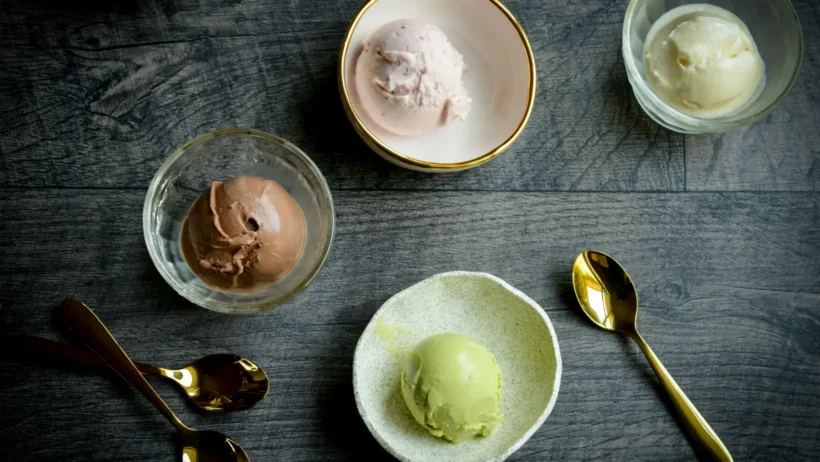

Under FSSAI rules, ice cream must get its fat from milk. Frozen dessert may use edible vegetable oils instead. Both must hit 10% fat, 36% total solids and 3.5% protein, so the difference is the source of the fat, not how processed or how sweet the product is.
- What is the difference between frozen dessert and ice cream?
- What does FSSAI require for each one?
- Is frozen dessert unhealthier than ice cream?
- How can you tell which one you are buying?
- Why do ice creams contain gums and emulsifiers?
- Do gums and emulsifiers damage your gut?
- Is carrageenan safe?
- What should you check on an ice cream tub?
- What about children and people with sensitive digestion?
- The bottom line
- Frequently asked questions
- Sources
Pick up two tubs in an Indian supermarket and one will say ice cream while the other says frozen dessert in noticeably smaller type. Shoppers usually read that as real versus fake. The actual distinction is narrower, more specific, and written into FSSAI regulation.
What is the difference between frozen dessert and ice cream?
The source of the fat. Under FSSAI regulation 2.1.7(1), ice cream is made by freezing a pasteurised mix prepared from milk and products derived from milk, so its fat has to be milk fat. Under 2.1.7(3), frozen dessert or frozen confection may be made with milk fat and/or edible vegetable oils and fat.
That is the whole legal difference. A manufacturer using palm oil or another vegetable fat instead of dairy fat cannot call the product ice cream, and must label it frozen dessert. The regulation also caps the melting point of those vegetable fats at 37 degrees Celsius.
What the label does not signal is anything about sugar, additives, or degree of processing. Those vary just as much within each category as between them.
What does FSSAI require for each one?
The compositional thresholds are close to identical. Full-fat ice cream and full-fat frozen dessert both need at least 36% total solids, at least 525 g per litre by weight, at least 10% fat and at least 3.5% protein. The regulation differs in wording, not in the numbers.
| Requirement | Ice cream (2.1.7(1)) | Medium fat | Low fat | Frozen dessert (2.1.7(3)) |
|---|---|---|---|---|
| Fat source permitted | Milk fat only | Milk fat only | Milk fat only | Milk fat and/or edible vegetable oils and fat |
| Total solids | Not less than 36.0% | Not less than 30.0% | Not less than 26.0% | Not less than 36.0% |
| Weight per volume | Not less than 525 g/l | Not less than 475 g/l | Not less than 475 g/l | Not less than 525 g/l |
| Fat | Milk fat not less than 10.0% | More than 2.5% and less than 10.0% | Not more than 2.5% | Total fat not less than 10.0% |
| Protein | Milk protein not less than 3.5% | Not less than 3.5% | Not less than 3.0% | Total protein not less than 3.5% |
One subtlety worth knowing: for ice cream, protein is measured as milk protein using a nitrogen conversion factor of 6.38. For frozen dessert it is total protein at 6.25, which allows vegetable protein to count towards the minimum. That is the second place the two standards diverge.
Is frozen dessert unhealthier than ice cream?
Not automatically. Both must reach the same 10% fat and 36% total solids, so the question is what kind of fat you are eating rather than how much. Milk fat is high in saturated fat. Vegetable fats vary widely, and some tropical oils used in frozen desserts are also high in saturated fat, so the swap is not reliably an improvement or a downgrade.
The genuinely useful comparison happens on the nutrition panel, not on the category name. Two tubs in the same category can differ substantially in added sugar and in saturated fat, and that difference is usually larger than the ice cream versus frozen dessert gap.
There is one clear consumer-protection point in favour of the labelling rule. If you are choosing dairy specifically, for taste, for a dietary reason, or because you are paying a premium for it, the word on the tub tells you whether you are getting it.
How can you tell which one you are buying?
Look for the words frozen dessert or frozen confection on the pack. Manufacturers using vegetable fat are required to use them, so their presence is definitive. They are often printed small and placed away from the brand name, which is why so many shoppers miss them.
The ingredient list is the confirmation. Ingredients are declared in descending order of weight, so a frozen dessert will name an edible vegetable oil where an ice cream would name milk, cream or milk solids. If you see palm oil, palm kernel oil or interesterified vegetable fat, the product is a frozen dessert regardless of how the front of pack is styled.
Why do ice creams contain gums and emulsifiers?
Because frozen water forms ice crystals, and ice crystals feel gritty. Stabilisers bind free water so crystals stay small, and emulsifiers keep fat and water from separating during freezing, storage and the partial thawing that happens between the factory and your freezer. Without them, a tub that survives a supply chain would be coarse and icy.
FSSAI lists which ones are permitted in these products and caps them. Emulsifying and stabilising agents, singly or in combination, are limited to 10 g per kg. Microcrystalline cellulose as a thickener carries the same 10 g per kg cap.
| Additive | What it is | What it does in the tub |
|---|---|---|
| Guar gum | Extracted from guar beans, a legume grown widely in India | Thickens the mix and slows ice crystal growth |
| Carrageenan | Extracted from red seaweed | Stops the milk proteins and whey from separating |
| Xanthan gum | Produced by bacterial fermentation of sugars | Adds viscosity and body |
| Mono- and diglycerides of fatty acids | Fat-derived emulsifiers | Keep fat evenly dispersed, improve whipping and texture |
| Microcrystalline cellulose | Purified plant cellulose | Thickens and stabilises the frozen structure |
That 1% ceiling is worth holding onto, because it sets the scale for everything in the next section. Even a 100 g serving made at the legal maximum would contain no more than 1 g of all stabilisers and emulsifiers combined.
Do gums and emulsifiers damage your gut?
The honest answer is that this is an active research question, not a settled harm. Most of the alarming findings circulating online come from mouse studies and cell work. There is one controlled human trial, it is small, and it used a dose far above what a tub of ice cream delivers.
That trial is Chassaing and colleagues, published in Gastroenterology in 2022. It was a double-blind controlled feeding study in healthy adults: 9 people on an emulsifier-free diet and 7 people on the same diet plus 15 g per day of carboxymethylcellulose for 11 days. The CMC group showed a modest increase in postprandial abdominal discomfort and a shift in gut microbiota composition with reduced diversity.
Two things follow. The finding is real and worth taking seriously as a research signal. And 15 g per day of a single emulsifier is roughly fifteen times what a 100 g serving could legally contain from all stabilisers and emulsifiers put together, in a trial of 16 people over 11 days. That is a long way from evidence that ice cream damages your gut.
| Claim | Best available evidence | Tested in humans? | How settled |
|---|---|---|---|
| A specific emulsifier can shift gut microbiota composition | Chassaing 2022 Gastroenterology: 16 adults, 15 g/day CMC for 11 days, reduced microbiota diversity | Yes, but n = 16 and a very high dose | Preliminary signal, not established for normal intakes |
| Emulsifiers cause metabolic disease and colitis | Mouse feeding studies | No | Animal only, do not apply to people as written |
| Gums and emulsifiers cause leaky gut in the general population | No human trial supports this | No | Not established |
| Carrageenan is carcinogenic or genotoxic | EFSA 2018 re-evaluation found no concern on either count | Toxicological review | Not supported |
| Guar gum triggers IBS symptoms | Fermentable fibres can cause bloating in sensitive people, but partially hydrolysed guar gum has been studied as an IBS treatment | Mixed | Individual, not a general harm |
Is carrageenan safe?
European regulators reviewed it in detail in 2018 and did not find a safety problem at food levels, but they also did not close the file. EFSA’s re-evaluation of carrageenan (E 407) found no concern regarding carcinogenicity and no concern regarding genotoxicity.
The dose numbers give useful perspective. In a subchronic study in rats, the no-observed-adverse-effect level was 3,400 to 3,900 mg per kg of body weight per day, which was the highest dose tested. Chronic studies found no adverse effects up to 7,500 mg per kg per day, again the highest dose tested.
EFSA nonetheless made the group acceptable daily intake of 75 mg per kg of body weight per day temporary rather than permanent, because of uncertainties in the chemistry, exposure assessment and toxicological database, and asked for the evidence to be improved. So the accurate description is not “proven harmful” and not “fully cleared” either. It is under continued review.
What should you check on an ice cream tub?
Skip the additive list as your first move. It is the least informative part of the pack for most people, and it is where marketing has trained shoppers to look. The nutrition panel and the category name carry more signal.
- Ice cream or frozen dessert. Find the category word. It tells you whether the fat is dairy or vegetable, which is the one thing the regulation guarantees.
- Total sugar per 100 g. Compare tubs against each other. Within a category the spread is often wide, and this number will separate them faster than the ingredient list will.
- Saturated fat per 100 g. Relevant in both categories, since tropical vegetable oils and milk fat are both high in it.
- Protein per 100 g. Useful as a sanity check against the 3.5% minimum, and a rough indicator of how much dairy or protein solids are actually in the mix.
- Serving size on the panel. Figures are usually declared per 100 g while a portion is often 60 to 70 g or a whole 500 ml tub. Do the conversion before comparing.
What a panel cannot confirm is whether the declared values match what is inside the tub, or whether additives sit within permitted limits. That gap is what independent laboratory testing exists to close. You can see label accuracy scores and lab reports for ice cream brands tested in India on Unbox Health.
What about children and people with sensitive digestion?
For most children the relevant issue with ice cream is added sugar and portion size, not the stabiliser list. Both categories are energy-dense sweetened foods, and treating them as occasional rather than daily addresses far more than swapping one tub for another does.
People with irritable bowel syndrome or generally sensitive digestion are a different case, and their experience is individual. Fermentable ingredients including some gums can cause bloating in susceptible people, while partially hydrolysed guar gum has actually been studied as an IBS treatment. The same ingredient can help one person and bother another, which is why elimination and reintroduction beats blanket avoidance.
Lactose intolerance is the more common and better-defined issue with dairy ice cream in India. If dairy reliably causes symptoms for you, that is worth discussing with a doctor rather than self-diagnosing from an ingredient list, because the fix and the testing are straightforward.
The bottom line
Frozen dessert versus ice cream is a question about fat source and nothing else. FSSAI sets both at 10% fat, 36% total solids and 3.5% protein for the full-fat tier, so the category name tells you whether the fat came from milk or from vegetable oil, and stops there.
The additive fears attached to both categories are mostly extrapolated from mouse studies. The single controlled human trial used 15 g a day of one emulsifier in 16 people over 11 days, against a legal ceiling of 1 g of all stabilisers and emulsifiers combined per 100 g of product. That is a research signal worth following, not a verdict on your dessert.
If you want one habit to change, compare total sugar and saturated fat per 100 g across tubs before you compare ingredient lists. It is duller than the additive debate and it will change your purchase more often.
Frequently asked questions
Is frozen dessert unhealthier than ice cream?
Not automatically. Both must meet the same thresholds of 10% fat, 36% total solids and 3.5% protein in the full-fat tier, so the difference is the type of fat rather than the amount. Some tropical vegetable oils are also high in saturated fat. Compare sugar and saturated fat per 100 g instead.
How do I know if a tub is a frozen dessert?
Look for the words frozen dessert or frozen confection on the pack, which are mandatory when vegetable fat is used. Then check the ingredient list. If it names palm oil, palm kernel oil or interesterified vegetable fat where you would expect milk or cream, it is a frozen dessert.
Are the gums and emulsifiers in ice cream harmful?
There is no strong human evidence that they are at normal intakes. Most alarming findings come from mouse studies. The one controlled human trial used 15 g a day of a single emulsifier in 16 people over 11 days, whereas FSSAI caps all stabilisers and emulsifiers combined at 10 g per kg, or 1% of the product.
Why does ice cream need stabilisers at all?
Frozen water forms ice crystals, and large crystals make ice cream gritty. Stabilisers bind free water so crystals stay small, and emulsifiers stop fat and water separating during freezing, storage and partial thawing in transit. Without them a tub that has travelled through a supply chain would be coarse and icy.
Is carrageenan safe to eat?
EFSA's 2018 re-evaluation found no concern regarding carcinogenicity or genotoxicity, with no adverse effects in chronic rat studies up to 7,500 mg per kg body weight per day. However, EFSA made the acceptable daily intake of 75 mg per kg temporary, citing gaps in the data, so it remains under review.
Can people with IBS eat ice cream?
It depends on the individual. Some fermentable ingredients including certain gums can cause bloating in sensitive people, while partially hydrolysed guar gum has been studied as an IBS treatment. Lactose is the more common trigger with dairy ice cream. Elimination and reintroduction works better than blanket avoidance.
What should I actually check on an ice cream label?
Five things: whether the pack says ice cream or frozen dessert, total sugar per 100 g, saturated fat per 100 g, protein per 100 g, and the serving size used on the panel. Nutrition figures are usually declared per 100 g while a portion is often 60 to 70 g, so convert before comparing.
Sources
- Food Safety and Standards Authority of India. Food Safety and Standards (Food Products Standards and Food Additives) Regulations, 2011, regulation 2.1.7, Dairy Based Desserts and Confections. https://fssai.gov.in/cms/food-safety-and-standards-regulations.php
- Chassaing B, Compher C, Bonhomme B, et al. Randomized controlled-feeding study of dietary emulsifier carboxymethylcellulose reveals detrimental impacts on the gut microbiota and metabolome. Gastroenterology 2022;162(3):743-756. https://www.gastrojournal.org/article/S0016-5085(21)03728-8/fulltext
- EFSA Panel on Food Additives and Nutrient Sources added to Food. Re-evaluation of carrageenan (E 407) and processed Eucheuma seaweed (E 407a) as food additives. EFSA Journal 2018;16(4):5238. https://efsa.onlinelibrary.wiley.com/doi/10.2903/j.efsa.2018.5238
- Indian Institute of Food Processing Technology, Ministry of Food Processing Industries. FSSAI Licensing Procedure, Standards and Guidelines: Ice Cream. http://www.niftem-t.ac.in/icecreamfssai.pdf
Reviewed by: Mruga Dholakia, Food Scientist & Nutritionist | Last updated: August 2026