



Probiotics are live bacteria that confer a benefit when taken in adequate amounts. Prebiotics are non-living fibres that the bacteria already in your gut selectively feed on. Probiotics add microbes, prebiotics feed them, and FSSAI maintains a separate permitted list for each.
- What is the difference between prebiotics and probiotics?
- What exactly counts as a prebiotic?
- Is all fibre prebiotic?
- What does FSSAI allow in prebiotic and probiotic products?
- How much fibre do Indians actually need?
- What is prebiotic fibre actually proven to do?
- Which Indian foods are natural prebiotics?
- Do you need a prebiotic or probiotic supplement?
- What are the side effects of prebiotics and probiotics?
- How do you check a prebiotic or probiotic label?
- The bottom line
- Frequently asked questions
- Sources
The two words appear together on so many packs that most shoppers assume they are variations of the same thing. They are not. One is alive and the other is not, they work through completely different mechanisms, and in India they sit under separate schedules of the same FSSAI regulation.
Getting the distinction right changes what is worth buying. It also explains why the strongest evidence in this category is not about supplements at all, but about eating more of the fibre that Indian diets have been quietly losing as cereals became more refined.
What is the difference between prebiotics and probiotics?
Probiotics are live microorganisms that, taken in adequate amounts, confer a health benefit on the host. Prebiotics are non-living substrates, usually specific fibres, that host microorganisms selectively use to produce a health benefit. Probiotics add bacteria to the gut; prebiotics feed the bacteria already there.
| Prebiotics | Probiotics | |
|---|---|---|
| What it is | A non-living substrate, usually a specific fibre | Live microorganisms |
| How it works | Selectively fed on by beneficial gut microbes | Adds specific microbial strains to the gut |
| Typical examples | Inulin, fructo-oligosaccharides, galacto-oligosaccharides, resistant starch | Lactobacillus and Bifidobacterium strains |
| Everyday food sources | Onion, garlic, whole wheat, barley, oats, banana, chana, rajma | Dahi, fermented foods, specific supplement strains |
| Needs to stay alive | No | Yes, viability at end of shelf life matters |
| Indian regulation | FSSAI Schedule VIII, list of prebiotic compounds | FSSAI Schedule VII, list of permitted strains |
| Effect is specific to | The compound and the dose | The exact strain, not the species |
A product containing both is a synbiotic. The strain-specificity line in that table is the one most often ignored in marketing: evidence for one Lactobacillus strain does not transfer to another strain of the same species, so “contains Lactobacillus” tells you very little on its own.
What exactly counts as a prebiotic?
The working definition, set out in the 2017 ISAPP consensus statement, is a substrate that is selectively utilised by host microorganisms conferring a health benefit. Two conditions have to be met: selective use by beneficial microbes, and a demonstrated benefit. Being fermentable is not enough on its own.
The best-characterised prebiotics are inulin-type fructans, fructo-oligosaccharides and galacto-oligosaccharides. Resistant starch, the starch that survives digestion in the small intestine, behaves similarly and is abundant in cooked and cooled rice, potato and legumes, which is convenient for Indian diets.
Chicory root is the commercial source of most added inulin, which is why it appears in so many gut-health products and, in India, in coffee blends. The role of chicory in Indian coffee is a useful worked example of the same compound showing up where nobody markets it as a prebiotic.
Is all fibre prebiotic?
No, and this is the most common error in the category. Almost every prebiotic used in food is a fibre, but most fibre is not prebiotic, because it does not meet the selectivity test. The relationship runs one way only.
Wheat bran is the clearest example. It is highly effective at increasing stool bulk and relieving constipation, which is a genuine and well-established benefit, but it is fermented poorly and non-selectively. It is excellent fibre and not a prebiotic. Cellulose behaves the same way.
This matters practically because the two do different jobs. If the problem is irregularity, insoluble cereal fibre is the better answer. If the aim is to shift the microbiome, a specific prebiotic compound is. Whole grains supply both, which is part of why whole grain bread differs from refined in more than fibre grams.
What does FSSAI allow in prebiotic and probiotic products?
Both are governed by the Food Safety and Standards (Health Supplements, Nutraceuticals, Food for Special Dietary Use, Food for Special Medical Purpose and Functional Food) Regulations. Permitted probiotic strains are listed in Schedule VII, and permitted prebiotic compounds in Schedule VIII. Neither is an open category.
Two numbers in that regulation are worth knowing. A probiotic food must deliver at least 100 million colony forming units of the added organisms in the recommended daily serving. For adults, added prebiotic must not exceed 40 g per 2000 kcal per day.
No food business may use a probiotic organism outside Schedule VII unless the Food Authority has approved it separately. So a product naming a strain that appears nowhere in the schedule, without evidence of separate approval, is worth a second look before buying.
How much fibre do Indians actually need?
ICMR-NIN’s 2020 report frames dietary fibre as an intake relative to energy rather than a flat gram target, setting a safe limit of 40 g per 2000 kcal. FSSAI applies the same 40 g per 2000 kcal figure as the adult ceiling for added prebiotics, which keeps the two documents consistent.
Framing it per 2000 kcal is more useful than a single number, because fibre requirement scales with how much you eat. A sedentary adult woman on roughly 1660 kcal and an adult man doing heavy work on 3470 kcal do not need the same grams of fibre.
Where Indian diets fall short is refinement rather than quantity of grain. The same volume of atta, brown rice or barley carries substantially more fibre than maida or polished rice, so the practical lever is which form of the staple reaches the plate, not adding a new food.
What is prebiotic fibre actually proven to do?
The evidence is strong for two things, reasonable for a third, and thin for most of what appears in gut-health marketing. Cholesterol lowering by specific soluble fibres and constipation relief by cereal fibre are well established. Claims about mood, immunity and bone strength are not at the same level.
| Claim | Best available evidence | Tested in humans? | How settled |
|---|---|---|---|
| Soluble fibre lowers LDL cholesterol | Consistent trial evidence for beta-glucan from oats and barley, and for psyllium | Yes | Well established for these specific fibres |
| Cereal fibre relieves constipation | Wheat bran reliably increases stool bulk and frequency | Yes | Well established, and not a prebiotic effect |
| Prebiotics increase Bifidobacteria | Reproducible with inulin-type fructans and galacto-oligosaccharides | Yes | Established as a microbiome change; the downstream health benefit is less clear |
| Fibre improves blood sugar control | Trial and cohort data on whole grain and high fibre diets | Yes | Supported, but the effect comes from whole diets rather than isolated fibre |
| Prebiotics improve calcium absorption and bone health | Small studies, mostly in adolescents, on inulin-type fructans | Yes, limited | Preliminary, and not established for adults |
| Prebiotics improve mood or immunity | Mechanistic and early-stage human work | Limited | Not established |
The pattern is consistent: where a specific fibre has been tested at a specific dose for a specific outcome, the result usually holds. Where the claim is about the microbiome improving general wellbeing, the chain from measured bacterial change to felt benefit has not been demonstrated.
Which Indian foods are natural prebiotics?
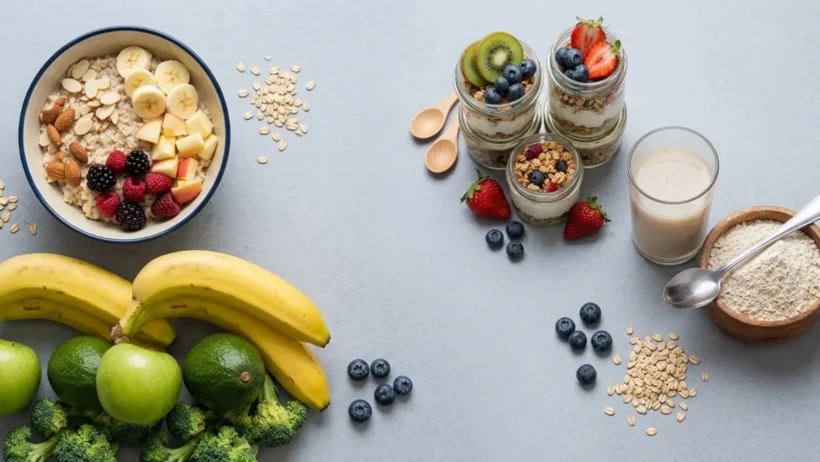
Most of them are already in an ordinary Indian kitchen. Onion and garlic supply inulin and fructo-oligosaccharides, legumes supply galacto-oligosaccharides and resistant starch, and whole grains supply both inulin and beta-glucan. Variety across these matters more than quantity from any single source.
| Food | Main prebiotic compound | Practical note |
|---|---|---|
| Onion, garlic, leek | Inulin, fructo-oligosaccharides | Used as a base in most Indian cooking already |
| Whole wheat, barley, oats | Inulin, beta-glucan | Lost when the grain is refined to maida or polished rice |
| Chana, rajma, other legumes | Galacto-oligosaccharides, resistant starch | Also the reason legumes cause gas in some people |
| Banana, especially less ripe | Fructo-oligosaccharides, resistant starch | Resistant starch falls as the fruit ripens |
| Cooked and cooled rice or potato | Resistant starch | Cooling after cooking increases resistant starch; reheating retains much of it |
| Chicory root | Inulin | The commercial source of most added inulin, including in coffee blends |
Dahi belongs in this discussion but on the other side of the line. It supplies live cultures rather than prebiotic substrate, so it is closer to a probiotic food, though the strains in household curd are not the characterised strains used in tested supplements.
Do you need a prebiotic or probiotic supplement?
Most people eating whole grains, legumes and vegetables regularly do not. A prebiotic powder delivers inulin or fructo-oligosaccharides reliably, but so does food, and food arrives with micronutrients attached. The case for a supplement rests on a specific gap rather than on general gut health.
Genuine reasons to consider one include a medically restricted diet, very low fibre intake that food changes have not fixed, or a doctor recommending a particular probiotic strain for a specific condition. That last case is the important one, because probiotic evidence is strain-specific and condition-specific.
What is not a good reason is a general promise of better digestion, immunity or mood. As the evidence table shows, those claims run ahead of what has been demonstrated, and the products carrying them are usually the most expensive in the category.
What are the side effects of prebiotics and probiotics?
For prebiotics the common effects are gas, bloating and abdominal cramping, most noticeable in the first two weeks or at higher doses. Inulin and fructo-oligosaccharides ferment quickly in the large intestine, which produces gas by design. Raising the dose gradually reduces the discomfort.
People with irritable bowel syndrome often react strongly, because inulin, fructo-oligosaccharides and galacto-oligosaccharides are FODMAPs, the short-chain carbohydrates that a low FODMAP diet restricts. For this group a prebiotic supplement can make symptoms worse rather than better, and is worth discussing with a doctor first.
Probiotics are generally well tolerated in healthy people, with mild gas or bloating early on. Caution applies to anyone who is immunocompromised, critically ill, has a central venous catheter, or has recently had major abdominal surgery. In those situations live organisms are a medical decision, not a wellness purchase.
How do you check a prebiotic or probiotic label?
For a prebiotic, look for the compound named specifically, not the word “prebiotic”, and the dose per serving in grams. For a probiotic, look for the full strain designation and a CFU count guaranteed at end of shelf life rather than at time of manufacture, since viability falls over time.
A strain is named to three levels: genus, species and strain code. Anything stopping at genus and species is incomplete, because the evidence attaches to the strain code. Cross-checking that the strain appears in FSSAI’s Schedule VII is a reasonable last step.
Unbox Health is India’s independent supplement and food testing platform, using NABL-accredited labs to verify products with no brand involvement. Lab-tested ratings and full reports for prebiotic and fibre supplements sold in India are published in full, including label accuracy results.
The bottom line
Prebiotics feed the bacteria you already have; probiotics add new ones. Almost all prebiotics are fibre, but most fibre is not prebiotic, and the two solve different problems: cereal fibre for regularity, specific prebiotic compounds for the microbiome.
The best-supported benefits, cholesterol lowering by beta-glucan and psyllium and constipation relief by cereal fibre, come from ordinary food. For most people the highest-value change is swapping refined staples for whole ones, which raises fibre and prebiotic intake at once and costs nothing extra.
Frequently asked questions
Is all fibre a prebiotic?
No. Almost all prebiotics used in food are fibre, but most fibre is not prebiotic. To qualify, a substrate must be selectively used by beneficial gut microbes and produce a health benefit. Wheat bran adds bulk and relieves constipation without meeting that selectivity test.
Do prebiotics or probiotics matter more?
Neither is universally better, they do different jobs. Prebiotics work with the microbes already in your gut and come free with a varied diet of vegetables, whole grains and legumes. Probiotic effects are strain-specific, so evidence for one product does not transfer to another.
How much fibre should an Indian adult eat daily?
ICMR-NIN's 2020 report sets a safe dietary fibre limit of 40 g per 2000 kcal of intake, and FSSAI applies the same 40 g per 2000 kcal ceiling to prebiotics in adult supplements. Most Indian diets fall short of that when cereals are refined rather than whole.
What are the side effects of prebiotics?
Gas, bloating and cramping, especially in the first two weeks or at higher doses. Inulin and fructo-oligosaccharides ferment quickly, so symptoms are common. People with irritable bowel syndrome often react strongly, since these compounds are FODMAPs. Increasing the dose gradually reduces the effect.
What does FSSAI require of probiotic products in India?
Only strains listed in Schedule VII of the Health Supplements and Nutraceuticals Regulations, or otherwise approved by the Food Authority, may be used. The viable count of added probiotic organisms should be at least 100 million colony forming units in the recommended daily serving. Prebiotic compounds are listed separately in Schedule VIII.
Can you get enough prebiotics from food without a supplement?
For most people, yes. Onion, garlic, whole wheat, barley, oats, bananas, chana and rajma all supply prebiotic compounds, and variety matters more than quantity from any single food. A supplement is useful mainly when the diet is genuinely restricted or a doctor has advised one.
Are prebiotic supplements worth the money?
It depends on the gap being filled. A powder delivering inulin or fructo-oligosaccharides does what the label says, but it substitutes for vegetables, legumes and whole grains that supply the same compounds alongside micronutrients. Check the compound named, the dose per serving, and whether it appears in FSSAI's Schedule VIII.
Sources
- Food Safety and Standards Authority of India (2016, as amended). Food Safety and Standards (Health Supplements, Nutraceuticals, Food for Special Dietary Use, Food for Special Medical Purpose and Functional Food) Regulations, including Schedule VII list of probiotic strains and Schedule VIII list of prebiotic compounds. fssai.gov.in
- Indian Council of Medical Research, National Institute of Nutrition (2020). Nutrient Requirements for Indians: Recommended Dietary Allowances and Estimated Average Requirements. ICMR-NIN, Hyderabad. nin.res.in
- Gibson, G.R., Hutkins, R., Sanders, M.E., Prescott, S.L., Reimer, R.A., Salminen, S.J. et al. (2017). Expert consensus document: The International Scientific Association for Probiotics and Prebiotics (ISAPP) consensus statement on the definition and scope of prebiotics. Nature Reviews Gastroenterology & Hepatology, 14, pp. 491-502. nature.com
- Hill, C., Guarner, F., Reid, G., Gibson, G.R., Merenstein, D.J., Pot, B. et al. (2014). Expert consensus document: The ISAPP consensus statement on the scope and appropriate use of the term probiotic. Nature Reviews Gastroenterology & Hepatology, 11, pp. 506-514. nature.com
- Slavin, J. (2013). Fiber and prebiotics: mechanisms and health benefits. Nutrients, 5(4), pp. 1417-1435. doi.org
Reviewed by: Mruga Dholakia, Food Scientist & Nutritionist | Last updated: August 2026