



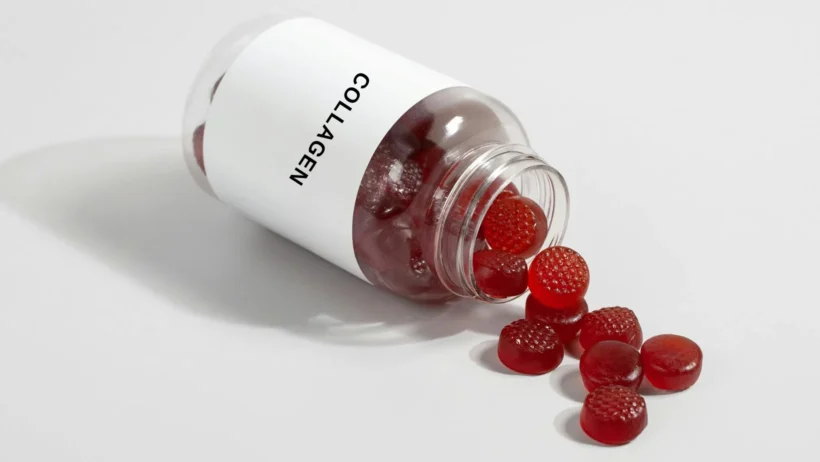

A 2021 meta-analysis of 19 randomised trials found 2.5 g to 10 g of hydrolysed collagen a day improved skin hydration, elasticity and wrinkles over about 90 days. Ninety five percent of the participants were women. India sets no supplement specific heavy metal limit for collagen, so product level testing matters.
- What is collagen and why does it decline with age?
- What are the proven benefits of collagen supplements?
- How strong is the evidence behind each collagen claim?
- Does collagen you swallow reach your skin?
- What are the types of collagen and which one matters?
- How much collagen per day did the trials use?
- Is vegan collagen actually collagen?
- What are the quality risks with collagen sold in India?
- What are collagen supplement side effects?
- How to choose a collagen supplement
- The bottom line
- Frequently asked questions
- Sources
Collagen’s best supported benefit is skin. A 2021 systematic review and meta-analysis in the International Journal of Dermatology pooled 19 randomised, double blind, placebo controlled trials covering 1,125 participants and found that hydrolysed collagen improved skin hydration, elasticity and wrinkles after roughly 90 days of daily use.
Two things that headline usually leaves out: 95 percent of those participants were women, and the popular explanation for why it works is not how digestion actually behaves. The quality question in India is separate again, and it is the one with the least published data.
What is collagen and why does it decline with age?
Collagen is the most abundant protein in the human body and the main structural protein in skin, bone, tendon and cartilage. It is what gives skin its firmness and what holds connective tissue together. Your body makes it continuously from amino acids, with vitamin C as an essential cofactor.
The decline is real but often described wrongly. The widely quoted figure of about 1 percent a year comes from a 1975 study by Shuster and colleagues, which measured forearm skin collagen in 148 people aged 15 to 93 and found a roughly linear fall across adult life at the same rate in both sexes.
That matters for how you read supplement marketing. The loss is gradual and lifelong, not something that switches on in your forties. Sun exposure and smoking accelerate skin collagen breakdown considerably, which is why photoprotection tends to outperform any oral supplement on skin ageing.
What are the proven benefits of collagen supplements?
One benefit is reasonably well supported: skin. The 2021 meta-analysis found favourable pooled results for hydration, elasticity and wrinkles against placebo, using doses of 2.5 g to 10 g a day. Its participants were aged 20 to 70, and the authors concluded that 90 days of use was the effective duration.
Joints are the second area with human data, but it is a different product. Undenatured type II collagen has been tested in randomised trials at around 40 mg a day, roughly a two hundredth of the skin dose, and appears to work through an immune tolerance mechanism rather than by supplying building blocks.
Hair and nail claims are the weakest of the common three. They appear on almost every Indian collagen pack, but they rest on far fewer controlled trials than the skin claim, and none of the large pooled analyses have made them their primary outcome.
How strong is the evidence behind each collagen claim?
Collagen claims are not all at the same level of proof, and the packaging rarely distinguishes between them. The table below separates what has been tested in people from what has been assumed.
| Claim | Best available evidence | Tested in humans? | How settled |
|---|---|---|---|
| Improves skin hydration, elasticity and wrinkles | 2021 meta-analysis: 19 randomised controlled trials, 1,125 participants, about 90 days | Yes, but 95% of participants were women | Reasonably supported |
| Eases joint discomfort | Randomised trials of undenatured type II collagen at around 40 mg a day | Yes, in smaller trials | Promising, less settled |
| Thickens hair and strengthens nails | Few controlled trials; largely a marketing claim | Limited | Unproven |
| Rebuilds skin collagen directly | No mechanism routes swallowed collagen to skin as collagen | No | Not supported |
| Vegan collagen supplies collagen | Plants do not produce collagen at all | Not applicable | False as worded |
Does collagen you swallow reach your skin?
Not as collagen. Your digestive system treats collagen exactly as it treats any other dietary protein: it breaks it down into amino acids and short peptides, which are absorbed and then used wherever the body needs them. There is no delivery route that sends them back to your face.
This is worth separating from the trial results. The randomised trials measured outcomes, not mechanism, and their skin findings stand on their own. What does not stand is the marketing image of swallowed collagen slotting itself into your dermis. Those are two different claims.
The practical consequence is that a collagen supplement is, nutritionally, a protein supplement with a distinctive amino acid profile that is high in glycine, proline and hydroxyproline. If your total protein intake is already low, that context is worth considering alongside any beauty claim.
What are the types of collagen and which one matters?
There are more than 20 collagen types in the body, but supplements realistically involve three. Which one you need depends entirely on the outcome you are after, and the source animal determines which type you get.
| Type | Where it sits in the body | Usual supplement source | What has been tested |
|---|---|---|---|
| Type I | Skin, bone, tendon; the most abundant collagen in the body | Marine, from fish skin and scales | Skin outcomes, at 2.5 g to 10 g a day |
| Type III | Skin and blood vessels, usually alongside type I | Bovine hide, typically as a type I and III blend | Bundled with type I; rarely tested alone |
| Type II | Cartilage | Chicken sternum | Joint outcomes, as undenatured collagen at around 40 mg a day |
The source also determines who can take it. Marine collagen is a fish product and is unsuitable for anyone with a seafood allergy. Bovine and porcine collagen carry dietary and religious restrictions for many Indian consumers, which makes accurate origin labelling more than a technicality here.
How much collagen per day did the trials use?
For skin, 2.5 g to 10 g of hydrolysed collagen a day, taken consistently for about 90 days. That range comes directly from the trials pooled in the 2021 meta-analysis, and the 90 day figure is the authors’ own conclusion about how long supplementation needs to run before effects show up.
For joints, the undenatured type II collagen trials used around 40 mg a day. This is not a smaller version of the skin dose, it is a different ingredient working a different way. A product offering 40 mg of collagen for skin benefits is not matching any skin trial.
Check the dose against the claim on your own pack. Many Indian collagen products bundle collagen with vitamin C, biotin and hyaluronic acid, which makes the collagen figure harder to find. If the label gives only a proprietary blend total, you cannot tell whether the trial dose is present at all.
Is vegan collagen actually collagen?
No. Collagen is an animal structural protein, and plants do not produce it. Any product marketed as plant based or vegan collagen contains no collagen, whatever the front of the pack implies. This is a definitional fact, not a matter of quality or brand.
What these products actually supply are collagen builders: the amino acids glycine, proline and lysine, usually with vitamin C, which is a required cofactor for your body to assemble collagen. That is a legitimate formulation. It is simply a different claim from delivering collagen.
Whether builders produce the same skin outcomes as hydrolysed collagen has not been established in comparable trials, so treat them as a separate category rather than a vegetarian equivalent. Unbox Health rates them separately too, on its vegan collagen ratings page.
What are the quality risks with collagen sold in India?
The largest risk is that nobody has published data on it. There is no systematic, India specific study of label accuracy, collagen content or heavy metal levels in collagen supplements sold here. That absence is the finding, and it is why product level testing carries more weight than usual in this category.
The regulatory position is also narrower than most buyers assume. FSSAI’s own FAQ on the 2016 Nutraceutical Regulations states that these products must meet the Contaminants, Toxins and Residues Regulations, 2011 under the foods not specified category. In other words, there is no collagen specific or supplement specific metal limit.
| Metal | FSSAI limit applied to supplements, mg/kg | Basis |
|---|---|---|
| Lead | 2.5 | Foods not specified |
| Arsenic | 1.1 | Foods not specified |
| Cadmium | 1.5 | Foods not specified |
| Mercury | 1.0 | Foods not specified |
| Methyl mercury | 0.25 | All foods |
Origin labelling is a documented problem elsewhere. A 2024 analysis in Marine Drugs tested ten collagen supplements from the Slovenian market and found collagen content was adequate in all of them, but two had origin problems: one listed marine collagen that most likely was not present, and one declared no origin at all. For religious diets and seafood allergies, that is the label line that matters most.
What are collagen supplement side effects?
Collagen is a protein, and reported side effects in trials are mild and mostly digestive: a feeling of fullness, bloating or an unpleasant aftertaste. It is generally well tolerated at the doses studied. The more meaningful risks come from what else is in the tub, and from who is taking it.
- Seafood allergy. Marine collagen is a fish product. If you react to fish or shellfish, avoid it or clear it with your doctor first.
- Unlabelled origin. Products that do not state the source animal cannot be assessed for allergen or dietary suitability, which the 2024 Marine Drugs analysis found in one of ten products tested.
- Kidney disease or a protein restricted diet. Collagen adds to your daily protein load. Discuss it with your doctor rather than adding it independently.
- Pregnancy and breastfeeding. There is little trial data in these groups, so the sensible default is to ask a doctor before starting.
Also note the trial population. Ninety five percent of participants in the 2021 meta-analysis were women aged 20 to 70. Findings from that group should not be assumed to transfer unchanged to men or to older adults outside that range.
How to choose a collagen supplement
Ignore the descriptors on the front. Korean, Japanese, premium and beauty are not quality parameters. Everything you need is on the back of the pack, or in a test report the brand either publishes or does not.
- A stated dose in grams, not a blend total. Compare it against the 2.5 g to 10 g used in the skin trials, or 40 mg if the product is undenatured type II for joints.
- A named source and collagen type. Marine type I, bovine type I and III, or chicken type II. An unstated origin is a reason to skip it.
- An FSSAI licence number. Its absence on a packaged supplement sold in India is a red flag.
- A third party test report. Given there is no supplement specific metal limit in India, an independent report covering heavy metals and actual collagen content does more work here than in most categories.
Where a brand does not publish its numbers, independent lab testing fills the gap. You can compare lab tested results across products on the Unbox Health collagen supplements ratings page. The same label reading logic applies across the category, as our guide to multivitamin label accuracy sets out.
The bottom line
Collagen is one of the better evidenced supplements in the beauty aisle, and one of the most oversold. The skin data is real: 19 randomised trials, 1,125 people, 2.5 g to 10 g a day, about 90 days. The mechanism people cite for it is not, and hair and nail claims are thinner still.
In India the open question is quality rather than efficacy. With no supplement specific heavy metal limit and no published Indian study on collagen label accuracy, the only way to know what is in a tub is a test report. Buy on the dose, the stated origin and the data, not the adjective.
Frequently asked questions
How much collagen should I take per day?
The trials pooled in the 2021 meta-analysis used 2.5 g to 10 g of hydrolysed collagen a day, taken for about 90 days before skin changes were measured. Undenatured type II collagen for joints is a completely different product and is studied at around 40 mg a day, not grams. Check which one your label describes.
What are the side effects of collagen supplements?
Collagen is a protein and is generally well tolerated. Reported effects are mild and digestive, such as fullness, bloating or an aftertaste. The more practical risks are allergic reaction if you are allergic to fish or shellfish and are taking marine collagen, and contamination, since India sets no supplement specific heavy metal limit for these products.
Is vegan collagen real collagen?
No. Plants do not produce collagen, so no plant derived product can contain it. Products sold as vegan collagen are collagen builders: they supply amino acids such as glycine, proline and lysine plus vitamin C, which your body needs to make its own collagen. That is a different claim from supplying collagen itself.
Which type of collagen is best for skin?
Type I is the collagen most abundant in skin, and marine collagen from fish skin and scales is predominantly type I. Bovine collagen supplies types I and III. Type II is a cartilage collagen aimed at joints, not skin. Most skin trials used hydrolysed type I or a type I and III blend.
Does India regulate heavy metals in collagen supplements?
Not with a supplement specific limit. FSSAI's own FAQ on the 2016 Nutraceutical Regulations states that these products must meet the Contaminants, Toxins and Residues Regulations, 2011 under the foods not specified category. Those default limits are 2.5 mg/kg lead, 1.1 mg/kg arsenic, 1.5 mg/kg cadmium and 1.0 mg/kg mercury.
Can collagen you swallow rebuild the collagen in your skin?
Not directly. Digestion breaks collagen down into amino acids and short peptides, the same as any other dietary protein, and there is no mechanism that routes them back to your skin as collagen. The trial results are real, but the popular explanation for them is not how the body works.
How do I check whether a collagen supplement is good quality?
Read the label for the collagen source and type, the dose in grams or milligrams rather than a proprietary blend, and an FSSAI licence number. Then look for a third party test report covering heavy metals and actual collagen content. Independent testing matters more here than marketing terms like marine, Korean or premium.
Sources
- de Miranda, R.B., Weimer, P. and Rossi, R.C. (2021). Effects of hydrolyzed collagen supplementation on skin aging: a systematic review and meta-analysis. International Journal of Dermatology, 60(12), pp. 1449-1461. pubmed.ncbi.nlm.nih.gov
- Kržišnik, N., Kurent, E. and Roškar, R. (2024). A Comprehensive Analytical Approach for Quality Control of Collagen in Food Supplements. Marine Drugs, 22(10), 435. mdpi.com
- Food Safety and Standards Authority of India (2021). Frequently Asked Questions on the Food Safety and Standards (Health Supplements, Nutraceuticals, Food for Special Dietary Use, Food for Special Medical Purpose and Functional Food) Regulations, 2016, Question 76. fssai.gov.in
- Food Safety and Standards Authority of India (2020). Compendium of Food Safety and Standards (Contaminants, Toxins and Residues) Regulations, 2011, Clause 2.1.1(2), Metal Contaminants. fssai.gov.in
- Shuster, S., Black, M.M. and McVitie, E. (1975). The influence of age and sex on skin thickness, skin collagen and density. British Journal of Dermatology, 93(6), pp. 639-643, as reviewed in Csekes, E. and Rackova, L. (2023). Biochemical, structural and physical changes in aging human skin. pmc.ncbi.nlm.nih.gov
Reviewed by: Mruga Dholakia, Food Scientist & Nutritionist | Last updated: July 2026