



Curcumin is the active compound in turmeric, making up only 2 to 5% of it by weight. It is barely absorbed, chemically unstable, and despite more than 120 clinical trials, a 2017 review in the Journal of Medicinal Chemistry found no double-blinded placebo-controlled trial of curcumin has been successful.
- What is curcumin, and how is it different from turmeric?
- Which curcumin benefits are actually proven?
- Does curcumin help with joint pain?
- Why is curcumin so poorly absorbed?
- Does piperine really boost curcumin absorption by 2000%?
- Is Indian turmeric contaminated with lead?
- Is curcumin safe, and who should avoid it?
- What should you check on a curcumin supplement label?
- The bottom line
- Frequently asked questions
- Sources
What is curcumin, and how is it different from turmeric?
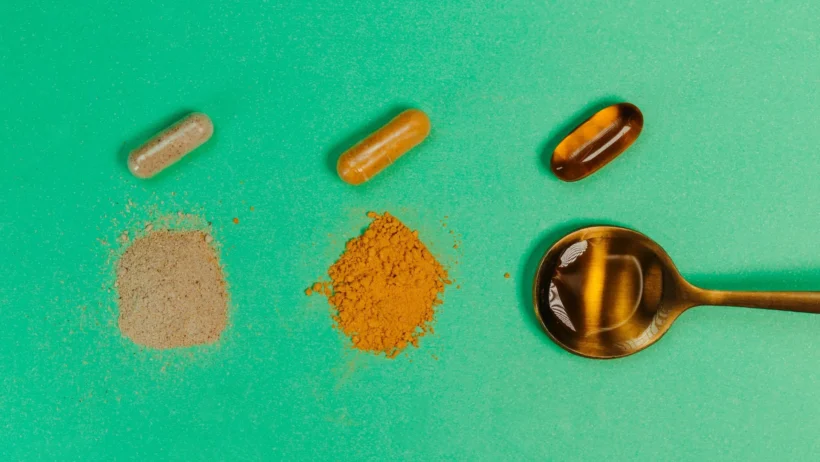
Turmeric is the whole rhizome. Curcumin is one compound inside it, and it accounts for only about 2 to 5% of turmeric by weight. Curcumin gives turmeric its yellow colour, but a spoon of haldi in a dal delivers a very small amount of it. A supplement standardised to 95% curcuminoids is a different thing entirely.
| Turmeric powder | Curcumin extract | |
|---|---|---|
| Curcuminoid content | Roughly 2 to 5% by weight | Typically standardised to 95% |
| Typical use | Cooking, a few grams a day | Capsule, a supplement dose |
| Regulatory category in India | Spice, food commodity | Nutraceutical or health supplement |
| Main quality risk | Adulteration, including lead chromate | Label accuracy and extract purity |
| Absorption | Very low | Very low without a delivery system |
That distinction matters for anyone deciding whether they need a supplement at all. Cooking with turmeric and taking a concentrated extract are different interventions, with different doses, different evidence and different safety questions.
Which curcumin benefits are actually proven?
Fewer than the category assumes. A 2017 review in the Journal of Medicinal Chemistry examined curcumin’s chemistry and its clinical record and reached a blunt conclusion: despite more than 120 clinical trials of curcuminoids across a range of diseases, no double-blinded, placebo-controlled clinical trial of curcumin has been successful.
The reason is chemical, not conspiratorial. That review classified curcumin as a pan-assay interference compound, or PAINS, meaning it produces apparent activity in laboratory tests through mechanisms unrelated to real biological effect. It also classified it as an invalid metabolic panacea. Both labels describe a molecule that looks promising in a test tube and disappoints in people.
| Claim | Strongest evidence | Tested in humans? | How settled |
|---|---|---|---|
| Anti-inflammatory activity in the laboratory | Cell and biochemical assays | Not as a health outcome | Real in vitro, confounded by assay interference |
| Knee osteoarthritis pain | Small clinical trials | Yes, but trials are small | Most studied use, still not conclusive |
| Cardiovascular health | Marker-based and mechanistic studies | No outcome trials | Not established |
| Gut and liver health | Mainly animal and small human studies | Limited | Not established |
| Cancer prevention or treatment | Cell-line and animal studies | No successful controlled trial | Not established, do not treat as therapy |
| Immune support | Mechanistic studies | No | Not established |
None of this makes curcumin harmful or pointless. It means the honest claim for a curcumin supplement in 2026 is “widely studied, not yet proven,” and any pack that promises more than that is ahead of the evidence.
Does curcumin help with joint pain?
Knee osteoarthritis is where curcumin has been studied most in people, and it is where the case for it is strongest. It is also where the limits of that case are clearest: the trials have generally been small, of variable quality, and have used different extracts and doses, which makes pooling them across studies difficult.
Set against that, the 2017 medicinal chemistry review found no double-blinded, placebo-controlled trial of curcumin to have been successful, across any indication. Anyone reading a joint-health claim on a pack is reading a claim built on the weaker end of that literature.
The reasonable position for a consumer is that curcumin may be worth trying for joint discomfort, is unlikely to cause harm at sensible doses, and should not replace a treatment plan agreed with a doctor. Persistent or worsening joint pain needs assessment, not a supplement.
Why is curcumin so poorly absorbed?
Curcumin is barely soluble in water, breaks down quickly in the gut and liver, and is cleared fast. In the human arm of the study that produced the best-known absorption data, volunteers given 2 g of curcumin alone had serum levels that were either undetectable or very low. Two grams is far more than any recipe delivers.
This is not a manufacturing flaw that better factories can fix. It is a property of the molecule, and it explains why so much of the supplement market is built around delivery systems: piperine, phospholipid complexes, nanoparticles and liposomal formats all exist to work around the same underlying problem.
It also explains a pattern worth recognising. When a compound performs well in cells but poorly in people, poor bioavailability is usually part of the answer, and curcumin is the textbook case.
Does piperine really boost curcumin absorption by 2000%?
The 2000% figure is real, published, and thinner than it sounds. It comes from a 1998 study in Planta Medica in which healthy volunteers took 2 g of curcumin with 20 mg of piperine, the active compound in black pepper, and showed a 2000% increase in bioavailability compared with curcumin alone.
Two things follow. First, the finding is nearly three decades old and rests on a small volunteer study, yet it underpins almost every piperine claim printed on curcumin packs sold today. Second, the same paper found a much smaller effect in rats, a 154% increase, which is a reminder of how much these numbers move between models.
The practical reading is that piperine plausibly helps and is cheap to include, so its presence is a reasonable thing to look for. A specific percentage printed on a pack, however, is a marketing number traceable to one 1998 study, not a property of that particular product.
Is Indian turmeric contaminated with lead?
Some of it is, and the data is recent and specific. A 2024 study in Science of the Total Environment sampled turmeric from wholesale and retail bazaars in 23 cities across India, Pakistan, Sri Lanka and Nepal, countries that together produce more than 80% of the world’s turmeric. It found detectable lead above 2 micrograms per gram in 14% of samples.
| Finding | Result |
|---|---|
| Cities sampled | 23, across India, Pakistan, Sri Lanka and Nepal |
| Samples with lead above 2 micrograms per gram | 14% |
| Highest level, Patna, Bihar | 2,274 micrograms per gram |
| Highest level, Guwahati, Assam | 127 micrograms per gram |
| Signature of deliberate adulteration | Lead to chromium ratio near 1:1 above 18 micrograms per gram |
| Projected effect on children | Blood lead up to 10 times the CDC threshold of concern |
Two clarifications keep this in proportion. The contamination was concentrated, not universal: in India it was most prominent in Patna, with one affected sample from Guwahati. And the study tested turmeric powder, the spice, not curcumin extract capsules, so the figures do not transfer directly to supplements.
What it does establish is that the turmeric supply chain feeding both spice and extract has a documented adulteration problem. Lead is a neurotoxin with no safe level of exposure, which makes heavy metal test data the single most useful thing a curcumin brand can publish.
Is curcumin safe, and who should avoid it?
Turmeric in food is safe at culinary amounts. Concentrated curcumin extracts are a different question, because a 95% curcuminoid capsule delivers a concentration no kitchen produces. Most people tolerate them, and the common complaints are digestive: nausea, loose stools, and abdominal discomfort, usually dose-related.
- Anyone on blood thinners or antiplatelet medicines. Curcumin may add to their effect, and this needs a doctor’s input.
- Anyone with gallstones or bile duct obstruction. Curcumin stimulates bile flow, which can worsen both.
- Anyone with an active liver condition. High-dose extracts have been linked to liver injury in published case reports.
- People taking iron supplements. Curcumin can bind iron and reduce absorption, which matters in a country with high anaemia rates.
- Pregnancy and breastfeeding. Supplement doses far exceed culinary amounts and have not been established as safe.
- Before surgery. Stopping curcumin a couple of weeks beforehand is a common precaution, given the bleeding question.
Nothing here argues against turmeric in cooking. It argues for treating a concentrated extract as a supplement decision, with the same caution any other supplement deserves.
What should you check on a curcumin supplement label?
Given that the evidence for benefit is unsettled, the sensible strategy is to minimise what can go wrong. That means judging a curcumin product on purity and honesty rather than on the health claims printed across the front of the box.
- Curcuminoid content, stated as a percentage and a milligram figure. “500 mg turmeric extract” tells you nothing without the standardisation.
- Heavy metal test data, especially lead. This is the single most important number for this category, given the documented adulteration of the turmeric supply chain.
- A named delivery system. Piperine, phospholipid or liposomal formats at least acknowledge the absorption problem instead of ignoring it.
- Batch-level third-party testing. A GMP claim describes the factory. A certificate of analysis describes the pack you are holding.
- No disease claims. A pack promising to treat or prevent a disease is telling you something about the brand, not the molecule.
None of these can be confirmed by reading marketing copy, which is the recurring problem across the supplement category. Independent lab testing is what closes that gap, and it is the basis on which Unbox Health rates lab-tested curcumin supplements sold in India.
The bottom line
Curcumin is one of the most researched natural compounds in the world and one of the least conclusively proven. It makes up 2 to 5% of turmeric, is barely absorbed, and after more than 120 clinical trials still has no successful double-blinded placebo-controlled result behind it. Knee osteoarthritis is the strongest use case and even that is unsettled.
That is not a reason to avoid turmeric, which belongs in Indian cooking on its own merits. It is a reason to buy a curcumin supplement with modest expectations and strict standards: stated curcuminoid content, published heavy metal testing given the documented lead chromate problem, and no disease claims on the pack.
Frequently asked questions
Are curcumin's health benefits actually proven?
Less than the marketing suggests. A 2017 review in the Journal of Medicinal Chemistry concluded that no double-blinded, placebo-controlled clinical trial of curcumin has been successful, despite over 120 trials. Curcumin is chemically unstable and poorly absorbed, and it interferes with many laboratory assays, which makes early positive results unreliable.
Does piperine really increase curcumin absorption by 2000%?
That figure comes from a single 1998 study in which healthy volunteers took 2 g of curcumin with 20 mg of piperine. It is real and it is published, but it rests on one small study from nearly three decades ago, and it is the basis for almost every piperine claim printed on curcumin packs today. Treat it as a plausible finding, not a settled one.
Why is curcumin so poorly absorbed?
Curcumin is barely soluble in water, is broken down quickly in the gut and liver, and is cleared fast. Serum levels after a 2 g oral dose have been reported as undetectable or very low in human volunteers. That absorption problem is the reason formulations add piperine, phospholipids or nanoparticles, and it is also why laboratory findings often fail to reproduce in people.
Is Indian turmeric contaminated with lead?
Some of it is. A 2024 study in Science of the Total Environment sampled turmeric from 23 cities across India, Pakistan, Sri Lanka and Nepal and found detectable lead above 2 micrograms per gram in 14% of samples. The maximum in Patna reached 2,274 micrograms per gram, with lead-to-chromium ratios pointing to deliberate lead chromate adulteration.
Does curcumin help with joint pain?
Knee osteoarthritis is where curcumin has been studied most in people and where the case for it is strongest. The counter-argument is that the trials have generally been small and of limited quality, and that no double-blinded placebo-controlled trial has been conclusively successful. Curcumin is not a substitute for a treatment plan agreed with a doctor.
Who should avoid curcumin supplements?
Anyone taking blood thinners or antiplatelet medicines, anyone with gallstones or bile duct obstruction, and anyone with an active liver condition should not start curcumin without medical advice. High-dose extracts have been linked to liver injury in case reports. Pregnancy and breastfeeding are also reasons to check with a doctor first, since supplement doses far exceed culinary amounts.
How much curcumin is safe to take daily?
There is no single agreed number, and doses used in trials vary widely. The practical point is that a 95% curcuminoid extract delivers a concentration you would never reach through food, so it should be treated as a supplement dose rather than a spice. Start low, take it with food, and stop if you notice nausea, diarrhoea or abdominal discomfort.
Sources
- Nelson, K. M., Dahlin, J. L., Bisson, J., Graham, J., Pauli, G. F. & Walters, M. A. (2017). The essential medicinal chemistry of curcumin. Journal of Medicinal Chemistry, 60(5), 1620 to 1637. https://doi.org/10.1021/acs.jmedchem.6b00975
- Shoba, G., Joy, D., Joseph, T., Majeed, M., Rajendran, R. & Srinivas, P. S. (1998). Influence of piperine on the pharmacokinetics of curcumin in animals and human volunteers. Planta Medica, 64(4), 353 to 356. https://doi.org/10.1055/s-2006-957450
- Forsyth, J. E., Mistree, D., Angrish, M., Nash, E. & Luby, S. P. (2024). Evidence of turmeric adulteration with lead chromate across South Asia. Science of the Total Environment. https://www.sciencedirect.com/science/article/pii/S0048969724051532
- Stanford Freeman Spogli Institute for International Studies. Evidence of turmeric adulteration with lead chromate across South Asia. https://fsi.stanford.edu/publication/evidence-turmeric-adulteration-lead-chromate-across-south-asia
Reviewed by: Mruga Dholakia, Food Scientist & Nutritionist | Last updated: July 2026