


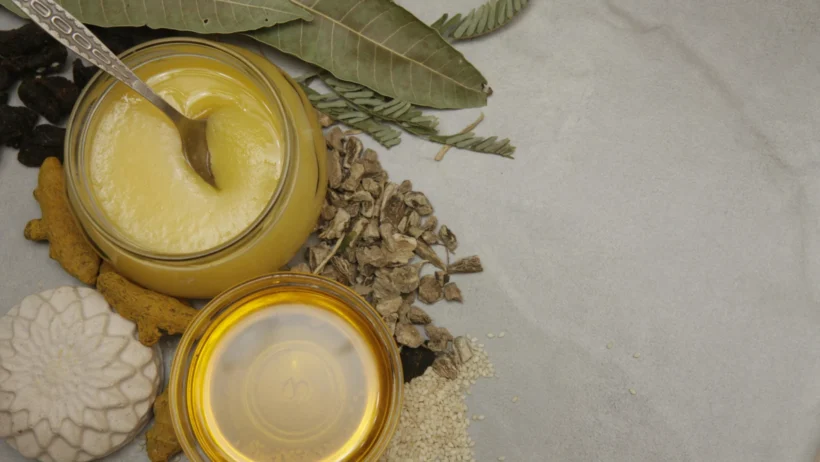

Ghee is at least 99.5 percent milk fat under FSSAI rules, so its real contribution is energy plus the fat soluble vitamins A, D, E and K. ICMR-NIN’s 2024 Dietary Guidelines cap ghee and butter at 1 to 2 teaspoons a day. The popular gut health claim rests on butyrate the colon makes itself, not on ghee.
- What is actually in ghee?
- What are the real benefits of ghee?
- Does ghee actually improve gut health?
- How strong is the evidence behind each ghee claim?
- How much ghee per day is safe?
- How common is ghee adulteration in India?
- What does a lab test for when it checks ghee purity?
- Do home purity tests for ghee work?
- Is bilona ghee or A2 ghee nutritionally better?
- Who should be careful with ghee?
- How to choose a ghee that is genuinely pure
- The bottom line
- Frequently asked questions
- Sources
Ghee’s real benefits are narrower than its reputation. Under FSSAI’s standard it must be at least 99.5 percent milk fat, which makes it a concentrated energy source that carries the fat soluble vitamins A, D, E and K. It is not a protein food, not a micronutrient source, and not, on current evidence, a gut health supplement.
That gap between what ghee is sold as and what it demonstrably does is worth closing before you pay a premium for a jar. The second question, equally practical in India, is whether the ghee in front of you is even ghee.
What is actually in ghee?
Ghee is milk fat with the water and milk solids removed. FSSAI’s Standard for Milk Fat Products sets the floor at 99.5 percent milk fat and a maximum of 0.5 percent moisture. Everything else that milk contains, protein, lactose, calcium, is present only in trace amounts, if at all.
That composition explains both its strengths and its limits. At roughly 9 kcal per gram of fat, 100 g of ghee delivers close to 900 kcal, and a level teaspoon of about 5 g works out to around 45 kcal. There is no meaningful protein or fibre to slow that down.
FSSAI also fixes the fatty acid profile. Adding the midpoints of its permitted ranges, saturated fatty acids account for roughly 64 percent of ghee’s fat, dominated by palmitic acid at 22 to 38 percent and stearic acid at 8 to 19 percent. Oleic acid, a monounsaturated fat, sits at 19 to 32 percent.
What are the real benefits of ghee?
Two benefits are uncontroversial. Ghee is a fat, and fat is required to absorb vitamins A, D, E and K from the rest of your meal, which matters in largely vegetarian Indian diets built on vegetables and dals. It also has a high smoke point, so it is chemically stable for Indian cooking temperatures.
A third, less discussed benefit is what ghee does not contain. Because the milk solids are removed, ghee carries almost no lactose or casein, which is why many people who react to milk tolerate it. That is a composition fact, not a therapeutic claim.
Beyond this, the picture thins quickly. Claims about immunity, weight loss and metabolism are extrapolated from laboratory or animal work on individual fatty acids, not from human trials on ghee itself. ICMR-NIN’s position is unambiguous: it groups ghee with butter and asks Indians to limit both.
Does ghee actually improve gut health?
This is the most widely repeated ghee claim and the weakest. The argument runs that ghee contains butyric acid, butyrate is good for the colon, therefore ghee is good for the gut. The middle step is correct. The link between the two is not.
Butyrate matters because it is the main energy source for colon cells and helps maintain the gut barrier. But the butyrate that does this work is produced inside the colon when gut bacteria ferment dietary fibre. Roughly 95 percent of short chain fatty acids are produced and absorbed in the colon itself.
Butyrate eaten in food behaves differently. Unprotected short chain fatty acids are absorbed high in the small intestine, well before they reach the colon. On top of that, FSSAI permits butyric acid at just 1 to 5 percent of ghee’s total fatty acids, so a teaspoon supplies a fraction of a gram.
The honest summary: if you want more colonic butyrate, eat more fibre. Dal, whole millets, vegetables and resistant starch from cooled rice do the job that ghee is credited with. This correction is not a criticism of ghee, it is a correction of a mechanism that was never tested.
How strong is the evidence behind each ghee claim?
Not every ghee claim sits at the same level of proof. Some follow directly from its composition and are effectively settled. Others rest on cell or animal studies of isolated fatty acids that were never fed to people as ghee. The table below separates the two.
| Claim | Best available evidence | Tested in humans as ghee? | How settled |
|---|---|---|---|
| Helps absorb vitamins A, D, E, K | Established nutrition science: these vitamins need dietary fat to be absorbed | Not needed, follows from composition | Settled |
| Very low in lactose and casein | FSSAI standard: minimum 99.5% milk fat, milk solids removed | Not needed, follows from composition | Settled |
| Stable for high heat cooking | High smoke point of clarified butterfat | Laboratory measurement | Settled |
| Improves gut health via butyrate | Butyrate research is on colonic fermentation of fibre, not dietary ghee | No | Not supported |
| Boosts immunity | Traditional use; no human trial on ghee and immune outcomes | No | Unproven |
| Aids weight loss | Ghee is roughly 900 kcal per 100 g; no human trial supports weight loss | No | Unproven |
How much ghee per day is safe?
ICMR-NIN’s 2024 Dietary Guidelines for Indians give a direct answer: limit ghee or butter to just 1 to 2 teaspoons a day, or avoid it if possible. That is roughly 5 to 10 g, or about 45 to 90 kcal, and it sits inside a wider cap on visible fat.
Visible fat is all the oil, ghee and butter you add during cooking, as opposed to the fat already inside grains, dals and nuts. ICMR-NIN sets that allowance by sex and activity level.
| Activity level | Adult women, visible fat per day | Adult men, visible fat per day |
|---|---|---|
| Sedentary | 20 g | 30 g |
| Moderate | 30 g | 40 g |
| Heavy | 40 g | 50 g |
Note that this is the total for all cooking fats combined, not a separate ghee budget. ICMR-NIN also caps total fat at 30 percent or less of daily energy. The WHO’s 2023 guideline adds a saturated fat ceiling of 10 percent of total energy, which two teaspoons of ghee alone would use about a quarter of.
How common is ghee adulteration in India?
Less common than the headlines suggest, but not rare enough to ignore. In FSSAI’s Pan-India Surveillance on Milk and Milk Products in 2023, 10,126 samples were collected across 756 districts in 36 states and union territories. Ninety eight percent were found safe for human consumption.
The failures were specific. Across all milk products, 421 samples were found adulterated, with starch, sodium chloride, foreign fat and sucrose named as the adulterants. Foreign fat is the one that matters most for ghee, since it covers vegetable oils and non milk animal fats passed off as milk fat.
Where you buy matters more than the overall number. Of those 421 adulterated samples, 292 came from the unorganised sector, where loose ghee is sold without a label, against 129 from packed, organised sector products. Loose ghee from an open tin carries measurably more risk than a sealed, labelled pack.
What does a lab test for when it checks ghee purity?
FSSAI does not rely on taste, texture or aroma. Its Standard for Milk Fat Products defines ghee through a set of measurable chemical constants, and a sample fails if any one of them falls outside range. Knowing the list helps you read a lab report instead of a marketing page.
| Parameter | FSSAI limit for ghee | What it catches |
|---|---|---|
| Milk fat | 99.5% minimum | Dilution with anything that is not milk fat |
| Moisture | 0.5% maximum | Water added to increase weight |
| Butyro-refractometer reading at 40 °C | 40.0 to 44.0 | Foreign fats with different optical density |
| Reichert-Meissl value | 24.0 minimum | Palm olein and animal body fats |
| Polenske value | 0.5 to 2.0 | Coconut and palm kernel oil |
| Free fatty acids as oleic acid | 2.0% maximum | Rancidity and poor storage |
| Baudouin test | Negative | Vanaspati, or hydrogenated vegetable fat |
| Beta-sitosterol | Absent | Any vegetable oil, since plants carry this sterol and milk does not |
The beta-sitosterol check is the most useful one to understand. Plant oils contain plant sterols and milk fat does not, so detecting beta-sitosterol in ghee is direct evidence of vegetable oil, no matter how well the flavour is masked. FSSAI notified an RP-HPLC method for this in March 2019.
Do home purity tests for ghee work?
Partly. The common kitchen tests can flag crude adulteration, but none of them measure the constants FSSAI actually uses, so a pass tells you very little. They are a screen, not a verdict, and FSSAI itself frames its household test kits as quick screening rather than confirmation.
| Home test | What it can show | What it misses |
|---|---|---|
| Melt in palm: pure ghee melts at body heat | Very heavily hydrogenated fat | Any adulterant with a similar melting point |
| Iodine drop: blue colour suggests starch | Starch or mashed potato as a filler | Vegetable oils, animal fats, vanaspati |
| Hydrochloric acid and sugar shake: red layer | Vanaspati, the same principle as the Baudouin test | Non hydrogenated vegetable oils; unreliable at home |
| Smell and grain texture | Nothing reliably | Almost everything, since flavour is easy to add |
For a definitive answer you need an accredited lab. India has 246 FSSAI-notified NABL-accredited food testing laboratories and 24 referral laboratories for appellate samples, which is the infrastructure that produces a real purity result rather than an indicative one.
Is bilona ghee or A2 ghee nutritionally better?
There is no published human evidence that bilona ghee or A2 ghee is nutritionally superior to conventionally made ghee. Both terms describe how the ghee was produced or which cow breed supplied the milk, and both carry a significant price premium. Neither is a purity guarantee.
The A2 argument is the easier one to settle. A1 and A2 refer to variants of beta-casein, a milk protein. Ghee is defined by the near total removal of milk solids-not-fat, so whichever casein the original milk carried, almost none of it survives into the finished ghee.
Bilona describes churning curd rather than cream to obtain butter. It is a real traditional method and may produce a different flavour, but the comparative nutritional claims made for it circulate largely in brand marketing rather than in peer reviewed literature. Treat them as unverified until a trial exists.
The practical point: a jar labelled bilona or A2 still has to clear the same FSSAI constants as any other ghee. The label describes provenance. Only a test describes purity. The same logic applies to other premium pantry claims, as our guide to checking honey purity sets out.
Who should be careful with ghee?
Ghee is safe for most people in the quantities ICMR-NIN suggests. The caution is about quantity and saturated fat, not toxicity. Some groups should be more deliberate about staying inside the 1 to 2 teaspoon range, or discuss it with their doctor.
- People with high LDL cholesterol or existing heart disease. Saturated fatty acids raise total and LDL cholesterol, which is the specific reason both ICMR-NIN and the WHO set limits on them.
- People managing weight. At around 45 kcal a teaspoon with no protein or fibre, ghee is easy to add and easy to underestimate.
- Anyone buying loose ghee. Unorganised sector samples accounted for 292 of the 421 adulterated milk product samples in FSSAI’s 2023 surveillance.
- People with a confirmed milk protein allergy. Ghee is very low in casein but not certified casein free, so clear it with your doctor rather than assuming.
None of this makes ghee a food to eliminate. It makes it a cooking fat to measure rather than pour, in the same way you would measure any other oil in the day’s visible fat budget.
How to choose a ghee that is genuinely pure
Skip the front of the pack entirely. Words like pure, desi, traditional and immunity are not regulated purity claims. What is worth reading is the ingredient list, the FSSAI licence number and, where a brand publishes one, an actual test report against the constants in the table above.
- One ingredient only. A ghee ingredient list should read milk fat, or butter, and nothing else. Added flavour, colour and preservative are not permitted in the raw material under FSSAI’s standard.
- A sealed, labelled pack over loose ghee. The surveillance data is clear on where the risk concentrates.
- An FSSAI licence number on the label. Its absence on a packaged product is a reason to put the jar back.
- A published lab report, not a certificate of intent. Look for named parameters and values, particularly the Baudouin test and beta-sitosterol.
Where a brand does not publish its own numbers, independent testing fills the gap. You can see how individual products score against these parameters on the Unbox Health ghee ratings page, which lists lab tested results by product rather than by brand claim.
The bottom line
Ghee is a good cooking fat with a reputation that has outgrown its evidence. It helps you absorb fat soluble vitamins, it handles high heat, and it is almost free of lactose and casein. It does not measurably improve gut health, and no human trial supports the immunity or weight loss claims.
The quantity question has a clear official answer: ICMR-NIN says 1 to 2 teaspoons a day, inside a total visible fat allowance of 20 to 50 g depending on sex and activity. The purity question has a clear technical answer too, and it is decided by a lab, not by a label.
Frequently asked questions
How much ghee can I eat in a day?
ICMR-NIN's 2024 Dietary Guidelines for Indians recommend limiting ghee or butter to 1 to 2 teaspoons a day, roughly 5 to 10 g. That sits inside a wider visible fat allowance of 20 g a day for sedentary women and 30 g for sedentary men, which covers all cooking oils combined.
Does ghee improve gut health?
There is no human evidence that it does. The claim comes from butyrate, which does support colon cells, but that butyrate is made inside the colon when bacteria ferment dietary fibre. Butyrate eaten in food is absorbed high in the small intestine. FSSAI also permits only 1 to 5 percent butyric acid in ghee.
How can I tell if my ghee is pure?
Home tests such as the iodine drop or palm melt check can flag crude adulteration but miss most of it. FSSAI defines ghee purity through lab constants: minimum 99.5 percent milk fat, a Reichert-Meissl value of at least 24, a negative Baudouin test and absent beta-sitosterol. Only an accredited lab can confirm those.
Is A2 ghee or bilona ghee better than regular ghee?
No published human study shows either is nutritionally superior. A2 refers to a beta-casein variant, and ghee retains almost no casein because milk solids are removed. Bilona describes churning curd instead of cream. Both may affect flavour and price, but neither guarantees purity, which still depends on lab testing.
Is ghee better than refined oil for cooking?
For high heat cooking ghee is stable and does not break down as readily as many refined oils. Nutritionally it is higher in saturated fat, at roughly 64 percent, than most seed oils. ICMR-NIN advises using a variety of fats rather than relying on one, and keeping total visible fat within the daily limit.
Can people who are lactose intolerant eat ghee?
Usually yes. FSSAI requires ghee to be at least 99.5 percent milk fat with the milk solids removed, so very little lactose remains and most people who react to milk tolerate ghee comfortably. Anyone with a diagnosed milk protein allergy, rather than lactose intolerance, should check with a doctor, since ghee is not certified casein free.
Does ghee raise cholesterol?
Saturated fatty acids raise total and LDL cholesterol, and roughly 64 percent of ghee's fat is saturated. That is why the WHO caps saturated fat at 10 percent of total energy and ICMR-NIN limits ghee to 1 to 2 teaspoons a day. Small measured amounts are fine for most people; large daily quantities are not.
Sources
- Food Safety and Standards Authority of India (2023). Food Safety and Standards (Food Products Standards and Food Additives) Regulations, 2011, Sub-regulation 2.1.8: Standard for Milk Fat Products, Version 1. fssai.gov.in
- Indian Council of Medical Research, National Institute of Nutrition (2024). Dietary Guidelines for Indians, Guideline 7: Use oils and fats in moderation, pp. 51-56. nin.res.in
- Ministry of Consumer Affairs, Food and Public Distribution, Government of India (2026). Lok Sabha Unstarred Question No. 855: Widespread Adulteration of Milk in the Unorganised Sector, answered 4 February 2026. fcainfoweb.nic.in
- Hodgkinson, K., El Abbar, F., Dobranowski, P., Manoogian, J., Butcher, J., Figeys, D., Mack, D. and Stintzi, A. (2023). Butyrate’s role in human health and the current progress towards its clinical application to treat gastrointestinal disease. Clinical Nutrition, 42(2), pp. 61-75. pubmed.ncbi.nlm.nih.gov
- World Health Organization (2023). Saturated fatty acid and trans-fatty acid intake for adults and children: WHO guideline. who.int
Reviewed by: Mruga Dholakia, Food Scientist & Nutritionist | Last updated: July 2026